China Top 10 Patient Room Lighting Suppliers?
Choosing among China’s top patient room lighting suppliers requires more than comparing catalog photos or headline prices. Patient room lighting affects visibility, comfort, and daily care routines, from reading at bedside to checking a chart after dark. Details matter.
A useful supplier review looks at product range, customization, documented quality processes, export experience, and responsiveness during sampling and production. Ask for clear specifications, such as color temperature, dimming options, control methods, and cleaning-compatible materials. Not just brightness. Request product data and sample units where practical, then check whether the finished light matches the stated specifications. A polished brochure is not proof of consistent manufacturing.
This article introduces ten suppliers for buyers to investigate, rather than presenting a universal ranking. Company capabilities and product lines can change, and a strong fit for one hospital project may not suit another. Consider room layout, clinical workflows, maintenance access, and the needs of patients and staff. Those details are easy to overlook.
The goal is to make early supplier research more focused. Use the list as a starting point, verify current certifications and references directly, and compare like-for-like products before making a decision. Even careful research has limits. Real project requirements should guide the final choice.
Patient Room Lighting: Clinical Functions, Fixture Types, and Care Settings
China Top 10 Patient Room Lighting Suppliers?
Patient Room Lighting: Clinical Functions, Fixture Types, and Care Settings
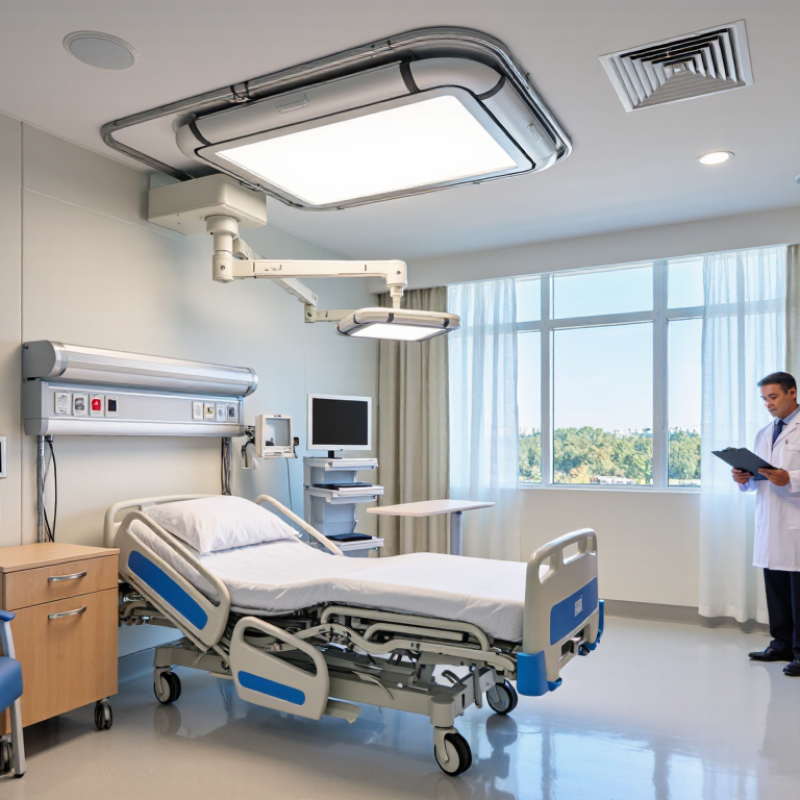
Patient room lighting must support observation, reading, movement, and rest. A layered setup usually combines broad ceiling illumination with adjustable bedside reading lights and focused examination lighting. Dimmable controls let staff check a patient without flooding the entire room with bright light. In recovery rooms and long-term care, warmer, lower evening settings can help create a calmer environment, though lighting alone cannot ensure better sleep.
Fixture choice should reflect the care setting. In acute-care rooms, sealed, easy-to-clean luminaires and well-positioned examination lights help with clinical tasks. In rehabilitation spaces, even illumination can make walking routes and floor transitions easier to see. The CDC reports that about one in four U.S. adults aged 65 and older falls each year. Good visibility may help staff and residents notice hazards, but it is not a cure-all. The Illuminating Engineering Society’s ANSI/IES RP-29-20 healthcare lighting guidance provides a professional basis for planning visual conditions. Real rooms still vary; one standard cannot solve every bedside need.
Tips: Check for glare from a reclined patient’s pillow position, not only from standing eye level. Keep night lighting low but sufficient to reveal the route to the bathroom. Small details matter.
Patient Room Lighting: Typical Illuminance by Clinical Function
Representative planning ranges in lux (lx). Appropriate levels vary by task, facility standards, and local regulations.
Lower light levels support nighttime orientation, while reading and examination tasks typically require higher illuminance. Use separately controlled lighting where possible to meet clinical needs while limiting disturbance to resting patients.
Illuminance Benchmarks: 100 lx for General Lighting, 300 lx for Examination
In a patient room, 100 lx is a practical benchmark for general lighting, while 300 lx can support routine bedside examination. Treat these as task targets, not universal guarantees. IES RP-29-16, Lighting for Hospitals and Healthcare Facilities, and CIBSE’s Lighting Guide 2 emphasize layered lighting and matching illumination to clinical tasks. A ceiling fixture may provide ambient light, while a separate adjustable luminaire directs light toward the patient. Small detail. Measure and record the plane: 100 lx at mattress height is not the same as 100 lx on the floor.
For examination, check that the light reaches the face or relevant body area without casting a clinician’s shadow. Confirm the reading with a calibrated lux meter under normal operating conditions, and note whether daylight or other fixtures are included. The 300 lx benchmark may suit a basic assessment, but detailed procedures can require different levels and specialist equipment. Glare matters, too; bright light in a patient’s eyes can make a technically adequate room uncomfortable. These targets are easy to list and harder to achieve evenly. Bed rails, curtains, and movable equipment can create dark patches, so measure more than one point and review the setup with clinical staff.
China’s Top 10 Suppliers: Products, Controls, Certifications, and Project Evidence
A useful review of China’s ten patient-room lighting suppliers should compare complete room solutions, not just fixture prices. Look for ambient ceiling lights, adjustable reading lights, examination lighting, and low-level night lights. Check whether the supplier can provide photometric data for each product. A bright sample in a showroom may feel harsh beside a patient’s bed.
Controls matter just as much. Ask for clear dimming ranges, bedside control options, and details on integration with nurse-call or building systems. Request wiring diagrams and a sample control sequence. Small gaps appear here. A control described as “compatible” may still need extra equipment or commissioning; confirm the exact configuration before comparing quotations.
Certifications should match the specific models and the destination market. Review current test reports, certificate scope, and product labels rather than relying on a general claim. For project evidence, request room layouts, installation photos, and references for comparable healthcare projects. Where possible, inspect a mock-up and test reading, examination, and night settings in person. Evidence can be uneven, and photographs rarely show glare or maintenance access. Record what remains unverified, including lead times, replacement parts, and warranty terms, before making a shortlist.
Technical Comparison: Color Rendering (Ra ≥80), Dimming, and Night Lighting
Patient-room lighting suppliers should be compared by measured performance, not catalog adjectives. CIE Publication 13.3 places general color rendering, Ra, on a 0–100 scale; specify Ra ≥80 and request test data at the actual operating setting.
Skin tone matters. A bruised arm or pale complexion must remain legible under bedside light. Ra alone is imperfect, though: it can hide weak reds or uneven color shifts.
IES TM-30-20 adds fidelity (Rf) and gamut (Rg) measures, giving buyers a more useful comparison than one number.
Dimming needs a real demonstration. Ask suppliers to show smooth control from full output to 1%, with no visible flicker, abrupt jumps, or buzzing. Check performance with the intended control system; a lamp that dims well on a bench may behave differently after installation.
ANSI/IES RP-29-16 addresses lighting for healthcare environments, but each room still needs task-specific review. Reading, examination, and overnight checks are not the same task.
Night lighting should guide staff without flooding a sleeping patient’s face. Test it bedside. Compare low-level output, glare from the pillow, and illumination at the floor.
A small, shielded source may work better than simply lowering the main ceiling light.
The uncomfortable question is often missed: can staff see safely without waking the patient?
Supplier Selection: Compliance, Lifecycle Costs, Warranty, and Service Coverage
When comparing patient room lighting suppliers in China, request current compliance documents for the destination market. Check electrical safety, photometric data, and compatibility with routine hospital cleaning. Ask whether test reports cover the exact fixture and configuration being quoted. Paperwork matters. A certificate for a similar model may not answer every question.
Look beyond the purchase price. Estimate energy use, driver and control replacements, installation access, and staff time spent maintaining fixtures. Ask for expected component lifetimes and replacement-part availability in writing. A low-cost fitting can become expensive if a ceiling must be opened repeatedly. These estimates are imperfect; actual service life depends on operating hours and maintenance.
Read warranty terms closely. Confirm coverage length, exclusions, labor costs, and who pays freight for replacement parts. Then check service coverage where the hospital operates: response times, local technicians, spare-parts stock, and commissioning support. Request references from comparable healthcare projects, and verify how faults were handled after installation. Do not assume remote support is enough. A supplier may provide fast answers online, yet still take weeks to deliver a critical component. That gap deserves attention.