
How to Choose Medical Gas Equipment for Global Supply?
Choosing Medical gas equipment for global supply requires more than comparing prices and product photographs. Hospitals depend on these systems for oxygen, medical air, nitrous oxide, vacuum, and other critical services. A poorly matched component can affect pressure stability, alarm performance, installation time, and patient care. The decision must connect clinical needs with engineering evidence.
Reliable purchasing begins with the intended application. Consider the gas type, flow rate, pressure range, connection design, cleaning requirements, and operating environment. A ward manifold may need different controls than an operating-room pipeline. Product files should include technical specifications, material information, inspection records, user instructions, and traceable quality documentation. Independent testing and verification can strengthen confidence, especially when equipment crosses borders.
Global supply also introduces practical questions. Can local technicians install and maintain the system? Are replacement parts available in the destination country? Will packaging protect delicate regulators, alarms, and valves during long transport? These details matter more than attractive catalog language. Experienced suppliers should explain limitations clearly and support commissioning, training, and after-sales service.
There is no flawless checklist.
Standards and procurement expectations vary by region, so qualified local professionals should review every selection before purchase. A product may perform well in one facility yet require adaptation elsewhere. That uncomfortable possibility deserves attention. Buyers should record assumptions, confirm compatibility, and reassess risks when specifications change. In medical gas projects, transparent evidence is not paperwork alone; it is part of safe, dependable global supply.
Understanding Medical Gas Systems and Their Equipment Requirements
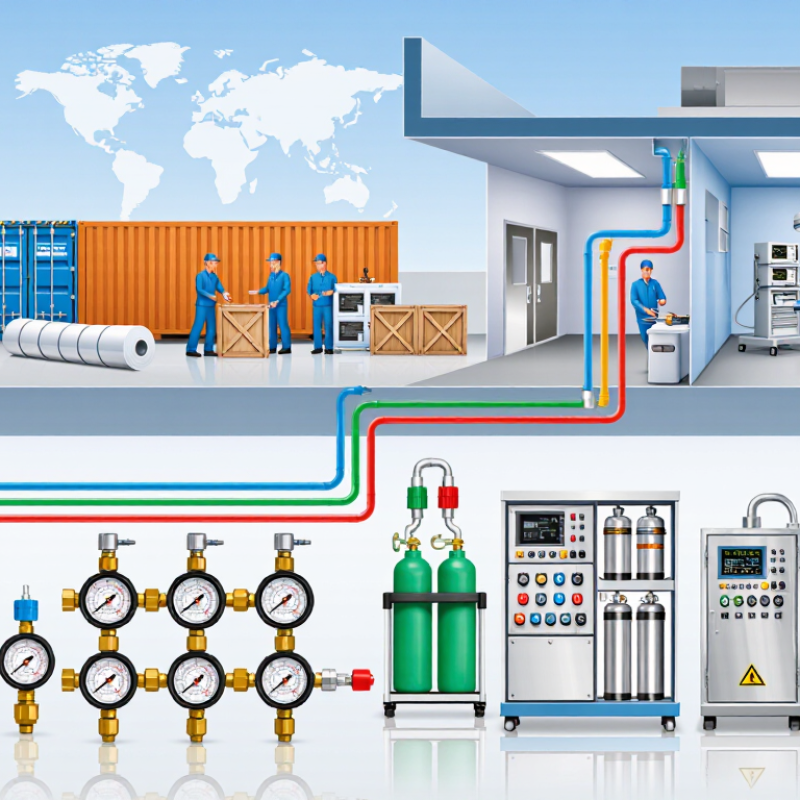
Choosing medical gas equipment for global supply begins with understanding the complete medical gas system. It is not simply a purchase of cylinders, outlets, or pipelines. The system may include oxygen, medical air, vacuum, nitrous oxide, alarms, regulators, manifolds, and terminal units. Each component must match the required pressure, flow rate, purity, and clinical purpose. Details matter.
A reliable assessment starts with the facility itself. A small clinic may need a compact manifold and basic alarm panel. A major hospital may require central supply rooms, emergency reserves, automatic changeover, and separated gas zones. Pipeline length also matters. Pressure loss can appear at distant operating rooms, especially when demand rises suddenly. Engineers should review local regulations, installation codes, labeling rules, and inspection procedures before selecting equipment. International projects often involve different socket designs and documentation requirements.
Maintenance needs equal attention. Clear access around cylinders, readable gauges, and spare seals can prevent delays during routine service. Equipment should support documented testing for leaks, pressure stability, contamination control, and alarm performance. A technically suitable system may still fail if staff cannot identify an alarm quickly. Small errors spread. It is tempting to choose one standard configuration for every country, but that approach can overlook climate, infrastructure, training, and emergency power limits. A careful supplier evaluates these conditions and records every assumption before production. Some specifications will need revision. That is not weakness; it is responsible engineering.
How to Choose Medical Gas Equipment for Global Supply? - Understanding Medical Gas Systems and Their Equipment Requirements
| System / Equipment | Typical Gas or Service | Primary Function | Common Operating Range* | Key Equipment Requirements | Global Supply Considerations |
|---|---|---|---|---|---|
| Bulk Storage or Cylinder Source | Oxygen, nitrous oxide, carbon dioxide, nitrogen | Provides the primary gas supply to the medical gas pipeline system. | Storage pressure depends on gas state and vessel type; pipeline delivery is commonly about 3.5–5 bar(g). | Suitable pressure vessels, pressure-reducing regulators, relief devices, isolation valves, non-return valves, and gas-specific connections. | Confirm local rules for cylinder handling, filling connections, transport classification, vessel certification, and emergency reserve capacity. |
| Automatic Changeover Manifold | Oxygen, nitrous oxide, carbon dioxide, nitrogen | Switches supply from an exhausted cylinder bank to a reserve bank without interrupting service. | Designed for the facility’s inlet pressure and peak flow; final settings are gas- and code-specific. | Dual banks, automatic or semi-automatic changeover, line relief, contents indication, pressure gauges, and audible/visual alarms. | Use gas-specific fittings and clearly different connection geometries to prevent cross-connection during installation or maintenance. |
| Medical Air Compressor System | Medical air | Generates clean, dry compressed air for ventilation, anesthesia, and clinical instruments. | Pipeline delivery is commonly about 3.5–5 bar(g); compressor discharge is higher and system-specific. | Oil-free compression, duty/standby capacity, air receivers, dryers, filtration, condensate management, bacterial control, and monitored air quality. | Verify electrical frequency, voltage, ambient temperature, altitude, humidity, replacement-filter availability, and local compressed-air quality limits. |
| Medical Vacuum Plant | Medical vacuum | Provides suction for airway management, drainage, surgery, and clinical procedures. | A commonly specified pipeline vacuum range is approximately −0.4 to −0.7 bar(g), subject to local design criteria. | Duty/standby pumps, bacterial filters, liquid separators, overflow protection, exhaust treatment, vacuum receivers, and automatic controls. | Assess liquid load, altitude effects, noise limits, exhaust location, maintenance access, and availability of compatible filters and service parts. |
| Oxygen Concentrator Plant | Oxygen-enriched product gas | Produces oxygen from ambient air using adsorption technology where an approved oxygen source is available. | Product concentration and pressure depend on the system; many medical applications use oxygen concentration of at least 90% by volume. | Redundant modules, product-gas monitoring, backup source, purity alarms, filtration, ventilation, and validated maintenance procedures. | Check local acceptance of concentrator-generated oxygen, required pharmacopoeial specification, power reliability, altitude derating, and backup autonomy. |
| Pipeline Distribution Network | Oxygen, medical air, nitrous oxide, nitrogen, carbon dioxide, vacuum | Transfers medical gases from the source to clinical areas and terminal outlets. | Positive-pressure gases are often designed around 3.5–5 bar(g); vacuum is designed separately. | Cleaned copper or approved piping, brazed joints using suitable purge procedures, supports, identification labels, isolation zones, and tested connections. | Select materials and joining methods accepted by the destination code; plan for climate, corrosion, seismic conditions, and local pipe-size conventions. |
| Area Valve Service Unit | All piped medical gases and vacuum | Allows authorized staff to isolate a defined ward, operating room, or clinical zone during an emergency or maintenance event. | Must withstand the full system pressure or vacuum and maintain safe shutoff performance. | Gas-specific valves, pressure gauges, clear labels, protected access, flow-direction markings, and provisions for emergency inlet connection where required. | Valve-box layout, labeling language, accessibility, fire-rating expectations, and alarm interfaces differ between jurisdictions. |
| Medical Gas Terminal Outlet | One dedicated outlet per gas or service | Provides a secure connection point for hoses, flowmeters, ventilators, anesthesia systems, and other medical devices. | Matches the pipeline design pressure, flow requirement, and gas-specific connector standard. | Mechanical gas indexing, check valves, clear gas identification, secure wall or pendant mounting, and compatibility testing with intended devices. | Connector profiles are not universally interchangeable; confirm the destination country’s terminal-unit standard before procurement. |
| Area Alarm and Master Alarm | Pipeline pressure, vacuum, source status, and reserve status | Warns clinical and engineering personnel about abnormal supply conditions. | Alarm thresholds are set around the approved design pressure and operational limits. | Audible and visual indicators, gas identification, alarm silence function, battery backup where required, remote contacts, and event logging. | Confirm signal protocol, mains voltage, language requirements, cybersecurity expectations, and integration with the facility management system. |
| Pressure Regulators and Relief Devices | All positive-pressure medical gases | Reduces source pressure and protects downstream equipment from overpressure. | Outlet settings must match the pipeline design and the connected medical devices. | Gas-specific construction, stable regulation across the expected flow range, relief protection, pressure gauges, and validated leak tightness. | Use oxygen-clean components where applicable; verify inlet threads, outlet connections, pressure units, calibration method, and spare-parts compatibility. |
| Flexible Hoses and Connection Assemblies | Gas-specific hose assemblies and vacuum hoses | Connects terminal outlets to mobile or fixed medical equipment. | Rated for the applicable pressure, vacuum level, flow, bending radius, and clinical environment. | Gas indexing, kink resistance, cleanable surfaces, secure end fittings, leak testing, correct length, and traceable material documentation. | Connector standards and color conventions vary; never rely on color alone and confirm dimensional compatibility before shipment. |
| Testing, Commissioning, and Documentation | Complete medical gas installation | Confirms identity, cleanliness, integrity, flow, pressure, gas quality, and safe operation before clinical use. | Test limits are defined by the applicable installation standard and project specification. | Pressure and leak tests, cross-connection tests, particulate and cleanliness checks, gas identification, alarm verification, as-built drawings, and commissioning records. | Agree on inspection authority, test certificates, language, calibration traceability, digital records, and handover requirements before production. |
Related Posts
-

2026 Best Labor and Delivery Equipment for Global Buyers?
-

Top Hospital Infrastructure Systems for Efficient Healthcare Delivery?
-

China Top 10 Hospital Installation Services You Need to Know?
-

China Best Headwall Accessories for Global Buyers?
-

Top 10 Headwall Accessories for Optimal Performance?
-

Top Medical Equipment Consulting Strategies for Global Buyers?