China Best Headwall Accessories for Global Buyers?

Choosing the right Headwall accessories requires more than comparing catalog prices. Global buyers must examine compatibility, safety, serviceability, and long-term performance. A hospital headwall may include medical gas outlets, electrical sockets, data ports, nurse-call systems, device rails, shelves, and lighting controls. Each component must fit the project’s clinical workflow and installation conditions.

Medical equipment planner David A. Clark observes, “A headwall is only as dependable as its smallest connection.” That principle matters in real hospital rooms. A loose rail clamp, poorly matched outlet, or difficult-to-clean surface can create daily problems for nurses and maintenance teams. Buyers should request material specifications, load ratings, connection standards, testing records, and replacement-part policies before approving a supplier. Stainless steel finishes may suit intensive-care areas, while modular designs can support faster upgrades. Small details often decide the result.

Reliable sourcing also requires practical experience. Ask whether the supplier has completed comparable projects, supports multilingual documentation, and understands regional installation requirements. Product photos are not enough. Request samples or technical drawings when possible. Even experienced buyers can overlook cable routing, clearance around beds, or access for future servicing. That is where this subject becomes less perfect than a brochure suggests. The “best” Headwall accessories may not be the most advanced or cheapest options. They should be safe, compatible, maintainable, and suitable for the people using them every shift. This guide compares the features global buyers should verify before making a confident decision.
China Best Headwall Accessories for Global Buyers?

What Are Headwall Accessories and Why Do Global Buyers Need Them?

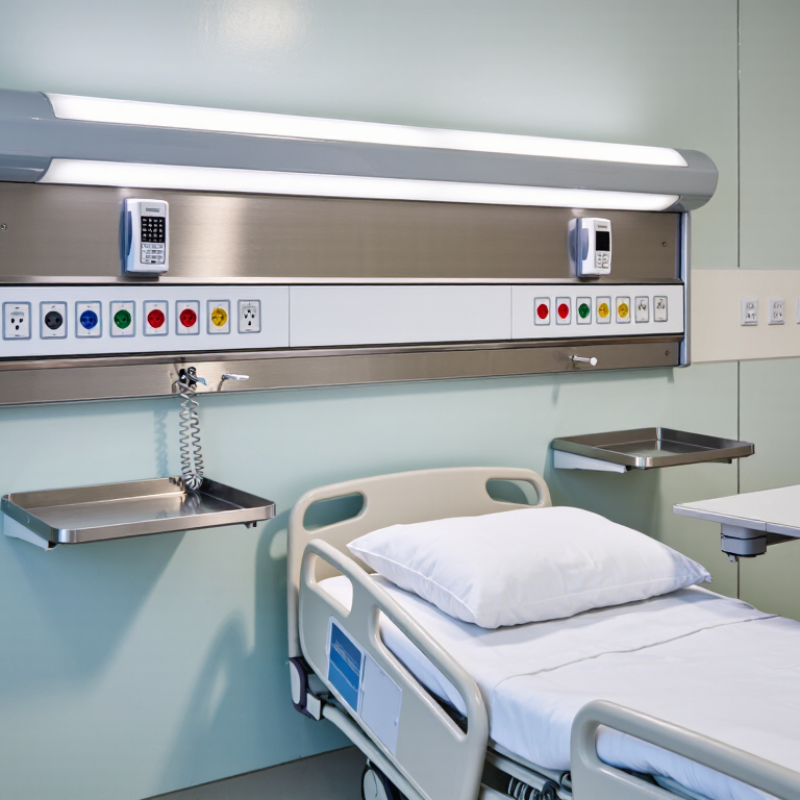
Headwall accessories are the working parts installed around a hospital bed. They include medical gas outlets, electrical sockets, data ports, rails, shelves, brackets, lights, and cable covers. Together, they connect clinical services with daily patient care. A nurse may reach an oxygen outlet, power a monitor, and adjust a reading light without leaving the bedside. Small details matter.

Global buyers need these accessories because a headwall must match local equipment, room layouts, and technical requirements. Buyers should check outlet types, voltage, connector standards, load capacity, dimensions, and cleaning needs. A shelf that fits one rail system may not fit another. During sourcing, request dimensional drawings, material information, inspection records, and clear sample photos. These documents support safer decisions and reduce installation delays.

Reliable suppliers should explain compatibility instead of offering vague packages. Destination-market requirements also need careful review. In practice, specifications are not always complete. A catalog may omit wall thickness, cable-routing space, or mounting limits. That gap can create costly adjustments on site. Ask precise questions before ordering. Check whether technicians can replace sockets and clean surfaces easily. I would also inspect finish quality, screw alignment, edge treatment, and packaging protection. One overlooked detail can affect both usability and maintenance.

China Best Headwall Accessories for Global Buyers?

What Are Headwall Accessories and Why Do Global Buyers Need Them?

Headwall accessories are integrated components used beside hospital beds, including medical-gas outlets, electrical sockets, data ports, nurse-call interfaces, reading lights, equipment rails, and storage modules. Global buyers should verify local medical-gas standards, outlet compatibility, electrical requirements, infection-control needs, and installation conditions before purchasing.

The chart shows common nominal pressure values used for medical-gas services in hospital pipeline systems. Medical vacuum is displayed as the magnitude of negative pressure. Actual specifications may vary by country, healthcare facility, and applicable standards, so buyers should confirm requirements with the project engineer and local regulations.

Which Headwall Accessories Are Essential for Different Healthcare Settings?

China Best Headwall Accessories for Global Buyers?

Different healthcare settings need different headwall accessories, not a longer product list. In general wards, essential items include oxygen and vacuum outlets, nurse-call controls, reading lights, electrical sockets, and data ports. The layout should leave clear space beside the patient. A crowded wall may appear efficient, but it can delay emergency access.

ICU headwalls require higher outlet density, flowmeters, suction regulators, equipment rails, monitor arms, and organized cable channels.

Recovery rooms add adjustable examination lights and easy-to-clean storage.

Isolation rooms need sealed surfaces, clearly labeled connections, and accessories that tolerate frequent disinfection.

The WHO Global Report on Infection Prevention and Control (2022) estimates that 7 of 100 patients in high-income hospitals acquire at least one healthcare-associated infection; the figure rises to 15 of 100 in low- and middle-income countries.

Cleaning access is not a minor detail.

Alarm and connection choices also deserve scrutiny. ECRI’s 2024 health technology hazard guidance highlights poor alarm management as a patient-safety concern. Buyers should therefore check nurse-call visibility, alarm audibility, connector identification, and emergency power support.

For international projects, request test records, material specifications, and installation drawings. Local requirements still matter.

A universal headwall rarely fits every ward perfectly.

The better approach is to test a full-size mock-up with nurses, cleaners, and biomedical engineers before ordering. Mistakes discovered early are cheaper.

How to Compare Materials, Designs, Functions, and Safety Standards

China Best Headwall Accessories for Global Buyers?
How to Compare Materials, Designs, Functions, and Safety Standards

Choosing headwall accessories from China requires more than comparing prices. Global buyers should examine materials, design details, functions, and documented safety performance. For frequent cleaning, stainless steel resists corrosion and surface damage. Aluminum is lighter, but thin profiles may dent during rough handling. ABS can reduce weight and cost. It may age poorly near heat or strong disinfectants. Small details matter.

Compare rail dimensions, load ratings, fixing points, and cable access before approval. A shelf that looks strong may flex when loaded with monitors and pumps. Check rounded edges, sealed joints, smooth surfaces, and replaceable components. These features support cleaning and reduce trapped dust. Ask whether oxygen, vacuum, electrical, and data connections match the planned clinical workflow. Do not accept “universal” without drawings. A practical sample exposes problems that photographs hide.

Safety evidence deserves careful review. Request material declarations, factory quality records, inspection reports, and applicable conformity documents. Depending on configuration and destination, references may include ISO 11197, IEC 60601-related requirements, or local medical-device rules. Verify certificate scope, test dates, model numbers, and translation accuracy. A certificate for one assembly may not cover every accessory. This is easy to miss. Suppliers should explain cleaning limits, installation torque, grounding, and maintenance intervals. The comparison is never perfect. Transparent evidence makes procurement safer and easier to defend.

China Best Headwall Accessories for Global Buyers? - How to Compare Materials, Designs, Functions, and Safety Standards

Accessory Category Common Materials Typical Design Options Primary Functions Typical Technical Data Relevant Safety and Compliance References Global Buyer Comparison Points
Medical Gas Outlet Panel Anodized aluminum, stainless steel faceplate, brass internal components, medical-grade seals. Flush-mounted or angled panel; single-gas or multi-gas configuration; concealed or exposed pipeline connection. Provides connection points for oxygen, medical air, vacuum, nitrous oxide, or other approved medical gases. Usually identified by gas-specific outlets; outlet quantity and mounting height are project-dependent; gas-specific connectors must not be interchangeable. ISO 9170-1 for terminal units; ISO 7396-1 for medical gas pipeline systems; local pressure, labeling, testing, and installation rules also apply. Confirm connector type, gas identity, outlet labeling, leakage testing, cleaning procedure, and compatibility with the facility pipeline system.
Electrical Socket and Data Module Flame-retardant engineering polymer, aluminum or stainless-steel trim, copper alloy contacts. Universal or country-specific socket layout; isolated medical-grade outlets; network, nurse-call, USB, or equipotential bonding modules. Supplies power and communication connections for patient-care and monitoring equipment. Voltage, frequency, socket form, circuit rating, IP rating, and number of outlets must be specified for the destination country and clinical area. IEC 60601-1 for medical electrical equipment interfaces where applicable; IEC 60364-7-710 for medical locations; national wiring and socket standards. Check local socket configuration, circuit segregation, protective earth, residual-current protection, load capacity, testing documentation, and EMC requirements.
Equipment Shelf Powder-coated steel, stainless steel, or anodized aluminum; edge trim may use medical-grade polymer. Fixed or height-adjustable shelf; flat, raised-edge, perforated, or slide-out design; optional retaining rail. Supports monitors, infusion accessories, small medical devices, and frequently used supplies. Typical working loads are commonly specified between 10 and 30 kg, but the permitted load depends on the mounting system and installation condition. IEC 60601-1 may apply when supplied as part of a medical electrical system; structural load, stability, sharp-edge, and cleaning requirements should be verified. Request static-load and stability test results, verify load distribution, inspect corner radii, and confirm resistance to hospital disinfectants.
IV Pole and Accessory Rail Stainless steel or anodized aluminum pole; aluminum or stainless-steel rail; polymer end caps and clamps. Fixed rail, vertical rail, telescopic pole, or detachable pole; two-hook to four-hook configurations are common. Holds infusion bags, syringe pumps, baskets, cable supports, and other approved accessories. Common pole adjustment ranges are approximately 500–900 mm; safe working load depends on hook count, pole diameter, clamp design, and mounting strength. ISO 15375 provides requirements for infusion containers and accessories; applicable medical-device, mechanical-safety, and hospital-furniture rules should also be reviewed. Compare anti-rotation features, hook security, clamp locking force, maximum load, pinch-point protection, and corrosion resistance.
Monitor Arm Aluminum arm, steel joints, stainless-steel fasteners, polymer cable guides. Single-screen or dual-screen; fixed, tilt, swivel, height-adjustable, or quick-release VESA mounting. Positions patient monitors and displays while reducing cable strain and improving visibility. VESA 75 × 75 mm and 100 × 100 mm patterns are widely used; arm load capacity and reach must match the monitor assembly. IEC 60601-1 may apply when integrated into a medical electrical system; VESA mounting dimensions and manufacturer load specifications should be verified. Check screen weight, center-of-gravity limits, locking performance, range of motion, cable bend radius, and wall or headwall reinforcement.
Cable Management System Halogen-free polymer channels, aluminum covers, stainless-steel clips, and low-smoke cable ties where required. Concealed raceway, hinged cover, vertical cable duct, under-shelf tray, or segregated power-and-signal routing. Organizes cables, reduces trip and snag hazards, supports cleaning, and helps maintain separation between power and data wiring. Capacity is determined by internal cross-sectional area, cable diameter, bend radius, ventilation needs, and required separation from medical gas lines. IEC 60364-7-710 and local electrical installation rules; fire, smoke, EMC, and cable-separation requirements depend on the destination market. Review flame rating, cleanability, access for maintenance, minimum bend radius, cable segregation, and resistance to repeated disinfectant exposure.
Privacy Curtain Track Anodized aluminum track, stainless-steel carriers, washable polyester or inherently flame-retardant curtain fabric. Straight, L-shaped, U-shaped, ceiling-mounted, or recessed track; manual or motor-assisted operation. Provides patient privacy and supports separation of treatment spaces. Track length and geometry are project-specific; carrier spacing, curtain drop, clearance, and ceiling load must be confirmed during design. Textile flame-performance requirements vary by country; applicable healthcare infection-control, ceiling-load, and accessibility requirements must be checked. Confirm washable fabric, flame classification, antimicrobial claims with test evidence, smooth carrier movement, and easy curtain replacement.
Patient Communication Module ABS or polycarbonate housing, aluminum trim, copper contacts, and medical-grade membrane switches. Nurse-call button, cancel button, emergency call option, room-light control, handset, and auxiliary interface. Enables patient-to-staff communication and selected room-control functions. Interface type may be wired or network-based; button layout, cable topology, power supply, and alarm prioritization must match the installed nurse-call system. IEC 60601-1 may apply to associated medical electrical equipment; nurse-call performance and emergency signaling requirements are governed by local regulations and facility specifications. Verify system interoperability, alarm visibility and audibility, backup power behavior, ingress protection, cleaning compatibility, and accessibility.
Buyer note: Technical values shown above are typical design ranges or commonly used configurations rather than universal requirements. Final specifications should be confirmed against the destination country's electrical, medical-gas, fire, infection-control, structural, and medical-device regulations.

What Should Global Buyers Check When Selecting a Reliable Supplier?

Selecting reliable headwall accessories requires more than comparing prices. Ask for material specifications, load ratings, dimensional drawings, and compatibility records. Stainless steel should resist repeated cleaning, while polymer parts need documented chemical resistance. Request samples and inspect edges, seams, fasteners, and cable routes by hand. Small defects matter.

The WHO Global Report on Infection Prevention and Control reports that healthcare-associated infections affect about 7 in 100 acute-care patients in high-income countries and 15 in 100 in low- and middle-income countries. Therefore, suppliers should explain cleaning validation, surface design, and replacement procedures. Check alignment with relevant requirements, including ISO 13485 quality systems and applicable IEC 60601 installation considerations. A certificate alone is not enough. Verify its scope, issuing body, and validity.

Supplier reliability also depends on evidence after delivery. Request factory audit records, batch traceability, inspection reports, and documented corrective actions. Ask how the supplier manages discontinued components and urgent replacements. A clear answer shows operational maturity. However, buyers should not assume every polished document reflects consistent production. Independent inspection, pilot installation, and real-user feedback remain valuable. For global projects, confirm packaging strength, language support, spare-part availability, and local technical service before signing. This is where many procurement plans become too optimistic.

How Are Headwall Accessories Installed, Maintained, and Customized?

Headwall accessories should be installed as clinical equipment, not decorative additions. Installation teams first verify wall structure, service routes, and load limits. Gas outlets, electrical sockets, data ports, rails, shelves, and examination lights need clearly separated connections. ISO 11197:2019 requires medical supply units to support safe construction and testing.

On-site commissioning should include leakage checks, polarity tests, grounding checks, and simulated equipment loads.
Small errors matter. A loose rail can become a falling hazard.

Maintenance begins with a visible schedule. Staff should inspect fasteners, outlet labels, cable strain, hinges, and surface damage during routine rounds. Cleaning agents must match the surface material, especially around seams and control panels. The World Health Organization reported that healthcare-associated infections affect about 7 in 100 acute-care patients in high-income countries, and 15 in 100 in low- and middle-income countries.

Headwalls cannot prevent infection alone, but smooth, accessible surfaces can reduce cleaning difficulties. One common weakness remains overlooked corners. They collect dust quietly.

Customization should follow clinical workflow rather than showroom appearance. A pediatric room may need lower accessory rails and protected data connections. An intensive-care room may require stronger equipment supports, additional power circuits, and clearer gas identification.

Before production, buyers should approve dimensional drawings, service matrices, material samples, and maintenance access. IEC 60601-1 testing may apply to integrated electrical equipment. I have seen attractive layouts fail because technicians could not reach the rear connections.

That detail deserves more attention. A practical factory acceptance test should reproduce the final room, including cables, monitors, cleaning clearance, and emergency access.