
Why Choose Picosecond Laser for Your Business?
Picosecond Laser is changing how modern aesthetic, dermatology, and tattoo-removal businesses evaluate treatment technology. It delivers ultra-short energy pulses, measured in picoseconds, to target selected pigments with limited heat exposure. For many clinics, this can support faster workflows, broader treatment options, and a more competitive patient experience. However, performance depends on the device, operator skill, patient profile, and treatment goals.
A sound business decision begins with evidence rather than impressive demonstrations. Review clinical research, regulatory documentation, warranty terms, service response times, and training quality before purchasing. Ask how the platform handles common concerns, such as uneven pigmentation, acne scars, and unwanted tattoos. Examine real treatment protocols, not only polished before-and-after photographs. A reliable supplier should explain contraindications, expected sessions, recovery requirements, and possible adverse effects clearly.
The financial case also deserves careful measurement. Calculate the purchase price, installation, consumables, maintenance, staff training, and room utilization. Compare these costs with realistic demand in your market. A Picosecond Laser may improve revenue, but returns are never automatic. Some assumptions may fail. Patient retention may be lower than expected, or additional clinical supervision may be necessary. Start with a documented consultation process and measurable goals, such as treatment completion rates, patient satisfaction, and downtime. When technology, clinical judgment, and honest communication work together, the laser becomes more than equipment. It becomes a responsible investment in patient care and sustainable business growth.
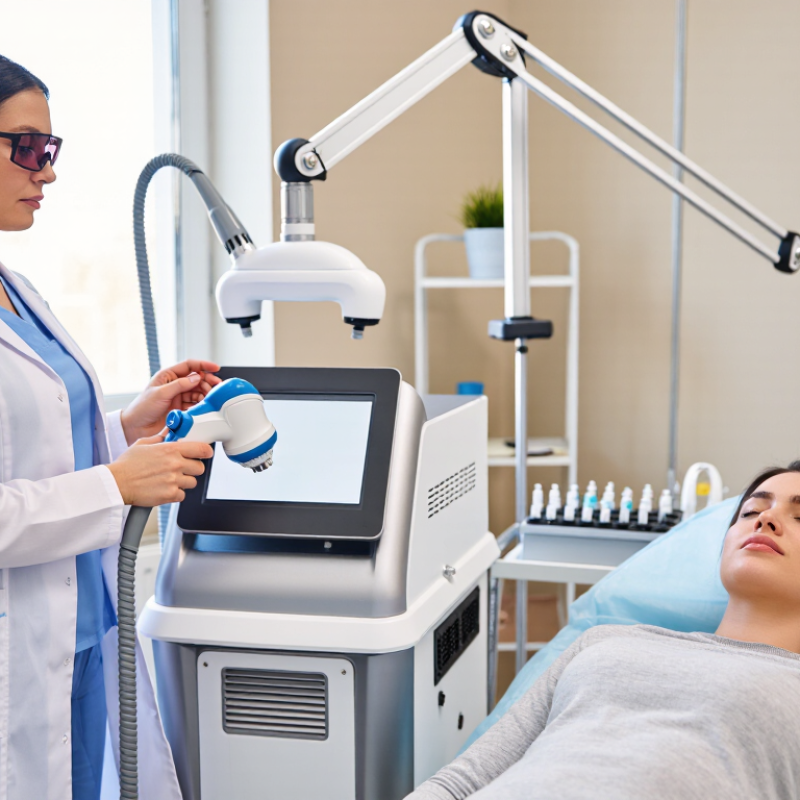
Define Picosecond Technology: Ultrashort 10⁻¹²-Second Laser Pulses
Why Choose Picosecond Laser for Your Business?
Picosecond technology uses ultrashort laser pulses lasting about 10⁻¹² seconds. This brief duration can deliver high peak power with less surrounding heat. The process may help break selected pigments or surface materials into smaller particles. A controlled pulse often supports faster energy release and more precise treatment. It sounds simple. It is not magic.
For businesses, precision can improve workflow consistency and client confidence. However, results depend on wavelength, pulse energy, spot size, material type, and operator training. In practical use, technicians should inspect the target area, confirm settings, and record each adjustment. Cooling, protective eyewear, and calibrated equipment also matter. I have found that rushing setup creates avoidable variation. Some applications still require multiple sessions or repeated passes.
Tips: Start with a professional assessment and a documented test area. Match the wavelength to the target, not the marketing claim. Use conservative settings when conditions are uncertain. Review outcomes under consistent lighting and keep clear maintenance records. Ask qualified safety personnel to verify ventilation, electrical protection, and operating procedures. A reliable system needs skilled handling, not only impressive specifications.
Compare 532, 755, and 1064 nm Wavelengths for Treatment Versatility
Why Choose Picosecond Laser for Your Business?
A picosecond laser delivers extremely short pulses, allowing providers to tailor treatments to different skin concerns and pigment types. Its value depends not on one wavelength, but on choosing the right option for each client and using careful assessment. Results vary. Training and realistic consultations matter.
532 nm is commonly selected for superficial, warmer-toned pigment, while 755 nm can address selected pigmented lesions and may suit some tattoo colors. The 1064 nm wavelength reaches deeper targets and is often considered for darker tattoo inks and a broader range of skin tones. These are not interchangeable settings. Skin type, pigment depth, treatment history, and the device’s approved indications all influence the choice. A wavelength chart alone cannot replace clinical judgment.
For a business, this range can support more varied treatment plans, but broader capability also brings responsibility. Before treatment, document skin appearance, discuss possible discomfort and temporary redness, and explain that multiple sessions may be needed. A small test area can help inform decisions, though it does not guarantee a particular outcome. Even experienced operators can misjudge pigment depth sometimes. That is worth taking seriously.
Wavelength and photon energy
Photon energy is calculated from wavelength using E = hc/λ. The displayed values are rounded. In aesthetic laser treatments, 532 nm is commonly used for selected superficial pigment targets, 755 nm for pigment and hair-removal applications, and 1064 nm for deeper targets and hair removal across a broader range of skin tones. Treatment suitability depends on the device, settings, skin type, and clinical assessment; wavelength alone does not determine versatility.
Assess Clinical Outcomes: Typical Tattoo Removal Requires 3–10 Sessions
Why Choose Picosecond Laser for Your Business?
A picosecond laser can support a more measured tattoo-removal service. In clinical practice, complete removal commonly requires 3–10 sessions, not one dramatic appointment. The exact number depends on ink color, pigment depth, tattoo age, skin type, and the tattoo’s density. Black and dark blue pigments often respond more predictably. Some green, yellow, or layered colors may need additional sessions.
Results develop gradually. Treatment intervals commonly allow several weeks for the skin to recover and the body to clear fragmented pigment. A qualified practitioner should assess the tattoo under clear lighting, record its size, and photograph each visit. Protective eyewear, controlled settings, cooling, and careful aftercare matter. Mild redness, swelling, or temporary lightening can occur. Rarely, pigment changes or scarring may develop, especially when treatment is too aggressive.
Business owners should evaluate outcomes beyond marketing images. Ask for documented case histories, realistic consent forms, and staff training records. A consultation should explain why a client may need eight sessions instead of four. That conversation builds trust. It also exposes a practical weakness: session estimates remain estimates. Treatment response is not perfectly predictable. Careful follow-up helps clinicians adjust energy, spot size, and timing without rushing the process. Small improvements count. A fading tattoo, calmer skin, and consistent photographs provide stronger evidence than exaggerated promises.
Why Choose Picosecond Laser for Your Business? — Assess Clinical Outcomes
Evidence-informed treatment benchmarks for tattoo-removal services. Actual results vary according to tattoo characteristics, patient factors, treatment settings, and clinical assessment.
| Clinical Outcome or Business Metric | Picosecond Laser | Typical Clinical Benchmark | Factors Affecting the Result |
|---|---|---|---|
| Typical number of tattoo-removal sessions | Approximately 3–10 sessions for many tattoos, with difficult cases sometimes requiring more. | Multiple sessions are standard for laser tattoo removal rather than a single treatment. | Ink color, tattoo age, ink density, layering, location, skin type, immune response, and treatment interval. |
| Recommended treatment interval | Usually about 6–8 weeks between sessions to allow epidermal recovery and gradual clearance of fragmented pigment. | Shortening the interval does not necessarily accelerate clearance and may increase the risk of irritation. | Healing response, treatment area, fluence, spot size, skin condition, and clinician assessment. |
| Best-performing tattoo colors | Black and other dark pigments generally respond more predictably because they absorb a broader range of laser energy. | Dark pigments are commonly easier to treat than light, pastel, and fluorescent pigments. | Wavelength selection, pigment composition, depth, oxidation, and whether the tattoo contains mixed colors. |
| Response of resistant colors | May improve the management of some blue, green, and other resistant pigments when the appropriate wavelength and parameters are selected. | Some colors may respond slowly or incompletely, and certain pigments can be resistant to laser treatment. | Exact pigment chemistry, wavelength compatibility, pigment depth, and prior treatment history. |
| How the pigment is targeted | Very short picosecond pulses create strong photoacoustic and photomechanical effects that fragment pigment particles. | Longer nanosecond pulses primarily use photothermal and photomechanical effects to disrupt tattoo pigment. | Pulse duration, wavelength, fluence, spot size, repetition rate, and operator technique. |
| Visible fading after one session | Fading is gradual; early changes may become more noticeable over the following weeks as the body clears fragmented pigment. | Immediate complete clearance is not expected after one treatment. | Initial pigment load, ink depth, vascular and lymphatic clearance, patient health, and aftercare. |
| Common immediate skin responses | Transient whitening or frosting, redness, swelling, tenderness, and occasional blistering may occur. | These responses are recognized effects of laser tattoo treatment and should be monitored during healing. | Energy settings, skin type, treatment area, cooling, aftercare, and individual sensitivity. |
| Downtime and recovery | Many patients resume routine activities quickly, but the treated area may require protection and wound care during early healing. | Recovery is commonly measured in days to weeks depending on the reaction and tattoo size. | Blistering, crusting, infection risk, sun exposure, friction, and adherence to aftercare instructions. |
| Risk of pigmentary changes | Temporary hyperpigmentation or hypopigmentation can occur, particularly in darker skin types or after excessive energy delivery. | Careful parameter selection and strict sun protection are important for reducing avoidable pigmentary complications. | Fitzpatrick skin type, recent tanning, wavelength, fluence, inflammation, and individual healing response. |
| How to evaluate clinical success | Use standardized photographs, consistent lighting, tattoo-area measurements, color-specific fading scores, and adverse-event tracking. | Session count alone is not sufficient to demonstrate clinical performance. | Consistent documentation, validated assessment scales, patient-reported outcomes, and follow-up timing. |
| Business value for a clinic | Can support a structured, multi-session service with clear consultation, treatment planning, documentation, and follow-up protocols. | Patient satisfaction is influenced by realistic expectations, transparent pricing, safety, and visible progress. | Clinical expertise, device maintenance, staff training, treatment capacity, local regulations, and patient selection. |
Clinical note: Session counts and outcomes are estimates, not guarantees. Tattoo removal should be planned and performed by appropriately trained healthcare professionals after an individual skin and tattoo assessment.
Evaluate Safety Through IEC 60601-1 Compliance and Skin-Type Protocols
Why Choose Picosecond Laser for Your Business?
Safety should be assessed before speed, versatility, or treatment revenue. IEC 60601-1 provides a recognized framework for electrical safety and essential performance. It covers risks such as leakage current, insulation failure, overheating, and unstable power delivery. Ask for current test records, technical files, and documented maintenance procedures. A certificate alone is not enough.
Skin-type protocols should guide every treatment decision. Fitzpatrick skin type offers a useful starting point, not a complete assessment. Record recent tanning, medication use, sensitivity, and previous reactions. Use conservative settings for darker skin types and increase energy gradually. A small test area can reveal unexpected redness or pigment changes. Protect the patient’s eyes every time. No exceptions.
In daily practice, clear records improve trust. Log pulse energy, spot size, repetition rate, treatment area, and observed skin response. Operators should understand warning indicators and emergency shutdown steps. Training matters as much as equipment design. That point is easy to underestimate. I would also review protocols after unusual reactions, even when the device performed normally. No system removes clinical judgment. Careful follow-up remains essential.
Calculate Business ROI Using Treatment Volume, Pricing, and Payback Period
Why Choose Picosecond Laser for Your Business?
A picosecond laser can become a measurable revenue tool, not merely an equipment upgrade. The ISAPS 2022 International Survey reported 18.9 million non-surgical aesthetic procedures worldwide. That demand supports careful capacity planning, but demand alone does not guarantee profit. Treatment volume matters more than an attractive brochure.
Use this simple model: monthly treatments × average price = gross revenue. Then subtract clinician time, consumables, room costs, maintenance, financing, and marketing.
For example, 35 treatments monthly at $450 generate $15,750. If operating costs consume 30%, the estimated contribution is $11,025. A $120,000 purchase could reach payback in about 10.9 months. Real life is less tidy.
Track cancellations too.
The Global Wellness Institute valued the global wellness economy at $5.6 trillion in 2022, showing a broad consumer interest in wellness-related spending. However, this figure does not predict local laser demand. A clinic should test pricing with a limited campaign, record consultation-to-booking rates, and review results after 90 days.
Pricing at $450 may work in one city and fail beside a lower-cost competitor. Staff training, treatment speed, and safety protocols also affect capacity. Recalculate monthly, because a quiet winter or unexpected service invoice can change the payback period sharply.
