
How to Choose the Right Internet of Things IoT Trainer?
Choosing the right Internet Of Things (IOT) Trainer can shape how effectively learners understand connected technology. A strong trainer should explain sensors, gateways, cloud platforms, protocols, and data security with practical clarity. Theory alone is not enough. Learners need to connect a temperature sensor, inspect live data, and troubleshoot a failed device.
The best choice depends on your learning goals, technical level, and available equipment. Review the trainer’s teaching experience, industry projects, and knowledge of current IoT standards. Ask whether lessons include MQTT, REST APIs, edge computing, device management, and secure authentication. These details reveal whether the program reflects real workplace conditions. A reliable trainer should also provide structured exercises, readable documentation, and honest guidance about system limitations.
The room matters. A crowded lab with outdated boards may weaken an otherwise excellent course. Look for safe equipment, stable software, clear demonstrations, and support after each session. Practical evidence is valuable, such as project portfolios, learner feedback, and independently verifiable credentials. Be cautious of impressive claims without working examples. Proof matters more.
No shortlist is perfect. One trainer may offer deep engineering knowledge but explain concepts poorly. Another may communicate brilliantly but lack current deployment experience. I may also overvalue advanced tools when beginners need patient instruction. A thoughtful evaluation should balance expertise, teaching quality, reliability, affordability, and long-term relevance. The right trainer should help learners build confidence, question assumptions, and create IoT solutions that perform beyond a classroom demonstration.
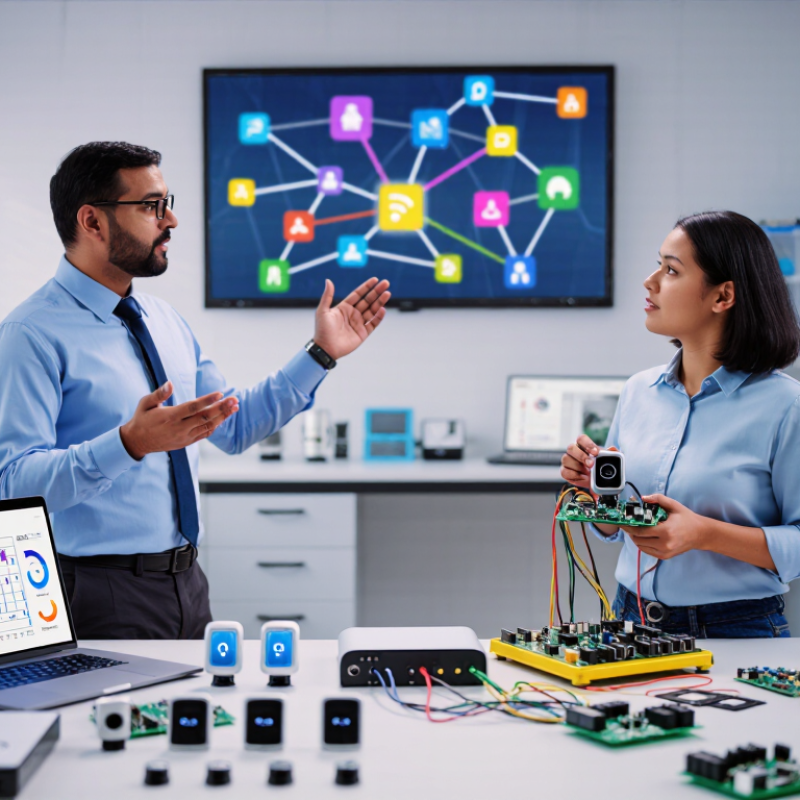
Understanding the Role of an IoT Trainer
How to Choose the Right Internet of Things IoT Trainer?
An IoT trainer does more than explain sensors, gateways, and cloud dashboards. They connect theory with physical decisions. Can learners wire a temperature sensor, inspect faulty data, and secure a device network? These moments reveal practical teaching quality. IoT Analytics reported 16.6 billion active IoT endpoints worldwide in 2023, with the number expected to reach 18.8 billion in 2024. That growth increases demand for trainers who understand hardware, connectivity, data platforms, and cybersecurity together.
Look for evidence of recent field experience. A strong trainer should show working prototypes, explain failed tests, and adapt lessons for different technical levels. Ask how they teach device identity, firmware updates, encryption, and data quality. The 2024 State of IoT report from IoT Analytics identifies connectivity, security, and interoperability as continuing industry challenges. A trainer who ignores these areas is incomplete. Very incomplete.
The trainer’s authority should also be verifiable. Check technical certifications, published work, project outcomes, and learner feedback from credible sources. NIST’s IoT cybersecurity guidance emphasizes secure configuration, data protection, and lifecycle management. Those principles belong in the classroom, not only in compliance documents. The best choice may not be the most polished speaker. It may be the person who admits uncertainty, welcomes questions, and improves outdated examples. That matters.
Identifying Your IoT Learning and Training Requirements
How to Choose the Right Internet of Things IoT Trainer?
Your training requirement should guide the trainer choice, not the other way around. Define the work first. Will learners connect sensors, analyze data, secure devices, or manage deployments? IoT Analytics reported about 16.6 billion connected IoT devices worldwide at the end of 2023. That scale demands practical learning, not only presentation slides.
Match the trainer’s experience to your environment. A manufacturing team may need vibration sensors, gateway configuration, and dashboard testing. A software team may need device APIs, cloud architecture, and data security. Ask for a sample lab, assessment method, and incident-based exercise. The National Institute of Standards and Technology recommends addressing device identity, secure updates, and data protection across an IoT product’s lifecycle. A qualified trainer should explain these controls clearly.
Set measurable outcomes before booking sessions. Learners might build a working sensor prototype, identify an insecure update process, or interpret abnormal temperature data. The World Economic Forum’s Future of Jobs Report 2023 found that 44% of workers’ skills could be disrupted within five years. Flexible trainers can update lessons as tools and threats change. Still, a checklist can mislead. A trainer may understand theory but struggle with a noisy workshop, weak connectivity, or confused beginners. I would test one short session first. Real learner questions reveal more than polished credentials.
| Learning Requirement | Typical Learner Profile | Recommended Trainer Capability | Evidence to Check | Suggested Priority | Evaluation Indicator |
|---|---|---|---|---|---|
| IoT Fundamentals | Beginners, students, and professionals moving into IoT | Can explain sensors, actuators, connectivity, gateways, cloud services, and data flows in clear terms | Structured beginner curriculum, diagrams, terminology review, and practical demonstrations | High | Concept clarity: 1–5 |
| Embedded Hardware | Engineering learners and technical development teams | Hands-on experience with microcontrollers, GPIO, analog and digital signals, power use, and hardware troubleshooting | Laboratory exercises involving sensor wiring, firmware deployment, and measurement of real signals | High | Practical lab coverage: 1–5 |
| Programming Skills | Learners with limited or intermediate coding experience | Teaches programming logic, device firmware, data handling, debugging, and code organization | Code examples, guided exercises, debugging activities, and assessment tasks | High | Code practice ratio: 30–70% |
| Wireless Connectivity | Professionals developing connected products or monitoring systems | Explains short-range and wide-area connectivity, bandwidth, range, latency, interference, and energy trade-offs | Comparison of Wi-Fi, Bluetooth Low Energy, cellular, and low-power wide-area use cases without assuming one solution fits all | High | Use-case accuracy: 1–5 |
| Cloud and Data Platforms | Software developers, analysts, and solution architects | Can teach device registration, message ingestion, storage, dashboards, APIs, and basic data processing | End-to-end project connecting a device to a secure data service and visualizing measurements | High | End-to-end completion: 1–5 |
| Cybersecurity | All learners working with connected devices or operational data | Covers device identity, authentication, encryption, secure updates, access control, network segmentation, and vulnerability management | Threat-modeling exercise, secure configuration checklist, and incident-response scenario | High | Security coverage: 1–5 |
| Industrial and Operational Context | Manufacturing, facilities, energy, logistics, and maintenance teams | Understands operational constraints, legacy equipment, safety procedures, reliability, and maintenance workflows | Realistic case studies covering condition monitoring, asset tracking, or predictive maintenance | High | Industry relevance: 1–5 |
| Project-Based Learning | Teams seeking measurable workplace outcomes | Can guide learners from requirements and architecture through implementation, testing, documentation, and presentation | Capstone project with defined milestones, acceptance criteria, and learner deliverables | High | Project maturity: 1–5 |
| Teaching Format | Remote, hybrid, or classroom learners with different schedules | Adapts demonstrations, group work, labs, recordings, and office hours to the delivery environment | Sample lesson plan, practical session schedule, learner support process, and accessibility options | Medium | Format fit: 1–5 |
| Assessment and Feedback | Organizations needing evidence of skill development | Uses practical tests, code reviews, design reviews, quizzes, and clear scoring criteria | Assessment rubric, progress reports, feedback turnaround time, and final competency record | Medium | Feedback quality: 1–5 |
| Tools and Equipment | Training groups with limited laboratory resources | Uses affordable, repeatable equipment and provides setup instructions, safety guidance, and alternatives for remote learners | Equipment list, per-learner cost estimate, loan process, and troubleshooting guide | Medium | Lab readiness: 1–5 |
| Trainer Experience | Organizations requiring practical and current instruction | Combines teaching experience with recent IoT implementation, testing, deployment, or operations experience | Relevant project portfolio, teaching references, sample materials, and evidence of continuing professional development | High | Experience relevance: 1–5 |
| Training Outcome | Managers selecting a program based on business or career objectives | Defines measurable outcomes such as building a prototype, analyzing device data, or producing a secure solution design | Outcome map linking each module to a demonstrable skill or workplace deliverable | High | Outcome alignment: 1–5 |
Evaluating Technical Skills and Teaching Experience
A strong IoT trainer needs more than broad technical knowledge. They should understand sensors, microcontrollers, communication protocols, gateways, cloud dashboards, and basic cybersecurity.
Ask how they would diagnose a temperature sensor that sends unstable readings. A capable trainer should explain the process clearly, from wiring checks to data validation and network logs.
Look for practical teaching experience, not only certificates. An experienced trainer can demonstrate a working project, then explain why it works. They should use real tools, such as circuit boards, serial monitors, packet captures, and simple data dashboards.
Good instructors adjust their pace when learners struggle. They invite questions and check understanding through short exercises.
Watch closely.
A reliable trainer also discusses limits and mistakes. They may admit that a previous lesson failed because a device overheated or a connection dropped. That honesty matters. IoT systems rarely behave perfectly in classrooms or field installations.
The trainer should explain safety, privacy, firmware updates, and responsible data handling without exaggeration. Ask for sample lesson plans, assessment methods, and learner feedback. Their answers should be specific, measurable, and easy to verify. A thoughtful trainer keeps learning, because protocols change and yesterday’s example may already be incomplete.
Comparing Training Methods, Tools, and Practical Projects
How to Choose the Right Internet of Things IoT Trainer?
A strong IoT trainer should connect theory with measurable practice. IoT Analytics reported 16.6 billion connected IoT devices in 2023, with 18.8 billion expected in 2024. That growth increases the need for structured, job-focused learning. Choose a trainer who explains sensors, connectivity, data handling, and security through clear demonstrations. Short lessons help, but practical feedback matters more.
Compare training methods carefully. Live workshops support questions and troubleshooting. Self-paced courses offer flexibility, yet learners may ignore difficult topics. A blended method usually works better: brief explanations, guided labs, and weekly reviews. Tools should include microcontrollers, basic sensors, network testing, dashboards, and safe cloud simulations. The equipment need not be expensive. It must be reliable.
Projects reveal a trainer’s real value. Ask for tasks such as monitoring room temperature, detecting water leaks, or measuring energy use. Each project should include wiring, code, data visualization, testing, and written security decisions. NIST guidance emphasizes identifying device risks throughout the system lifecycle. The World Economic Forum reported that 44% of workers’ skills may be disrupted within five years. Training should therefore build judgment, not only technical habits. I would question any course promising instant expertise. My own preference is practical depth, although repeated debugging can feel slow. That discomfort is useful.
How to Choose the Right Internet of Things (IoT) Trainer?
This comparison uses a transparent 1–5 selection rubric, where 5 represents the strongest fit. Project-based blended learning scores highest because it combines instructor guidance, simulation tools, hardware practice, troubleshooting, and a complete IoT project workflow.
Selecting an IoT Trainer Based on Value and Long-Term Support
How to Choose the Right Internet of Things IoT Trainer?
Selecting an IoT trainer requires more than comparing prices. Value includes hardware quality, learning outcomes, documentation, and support. A useful trainer should connect sensors, transmit data, and display results clearly. During a classroom trial, test temperature sensors, wireless communication, dashboards, and power stability. Watch how quickly learners can identify a fault. That moment reveals more than a product specification sheet.
I once evaluated a low-cost trainer that appeared attractive at first. Its sensors worked, but the instructions skipped basic wiring checks. Several learners lost time before finding a loose connection. The kit was affordable, but the teaching value was limited. A better choice provides structured experiments, sample code, circuit diagrams, and realistic troubleshooting tasks. Clear safety guidance also matters, even for low-voltage equipment.
Long-term support can determine the real cost. Ask whether firmware, software libraries, and learning materials receive regular updates. Check spare-part availability and the provider’s response process. Support should include practical answers, not only automated links. Independent reviews, pilot feedback, and verified technical specifications improve purchasing confidence. Still, no trainer remains perfect forever. Some updates may break older exercises, and replacement parts may become difficult to source. Leave room in the budget for maintenance, instructor training, and future expansion. A flexible trainer should support new sensors without forcing a complete system replacement.
