Why Use Aluminum Ferrules for Wire Rope Assemblies?
Wire rope assemblies often fail at details, not at the visible cable. The termination carries concentrated force. That is where an Aluminum Ferrule earns attention. When correctly matched and swaged, it creates a compact mechanical connection around the rope. It is light. It also offers useful corrosion resistance in many controlled environments. However, aluminum is not automatically suitable for every rope, load, or atmosphere. Saltwater, dissimilar metals, and poor compression can change the result quickly.
The Wire Rope Technical Board’s Wire Rope Users Manual emphasizes correct rope preparation, fitting selection, and termination inspection. ASME B30.9, Wire Rope, also highlights competent assembly practices and routine examination. OSHA guidance for wire rope systems reinforces the importance of inspecting damaged, distorted, or improperly secured components. These sources do not treat a ferrule as a decorative sleeve. They treat it as a load-bearing termination component. The practical difference matters.
A reliable installation begins with the manufacturer’s rope-size chart, ferrule alloy, and approved swaging dies. Installers should confirm the rope diameter with a calibrated gauge. They should also record compression settings and proof-test results when the application demands them. Small details matter. In field applications, aluminum ferrules can reduce assembly weight and simplify compact designs. They may suit lifting accessories, guard systems, marine hardware, and architectural cable work. But they are not automatically the strongest option. I would avoid presenting them as a universal replacement for steel sleeves. A credible selection considers working load, safety factor, environment, rope construction, and inspection access. The choice should be documented, tested, and reviewed. That distinction is easy to miss.
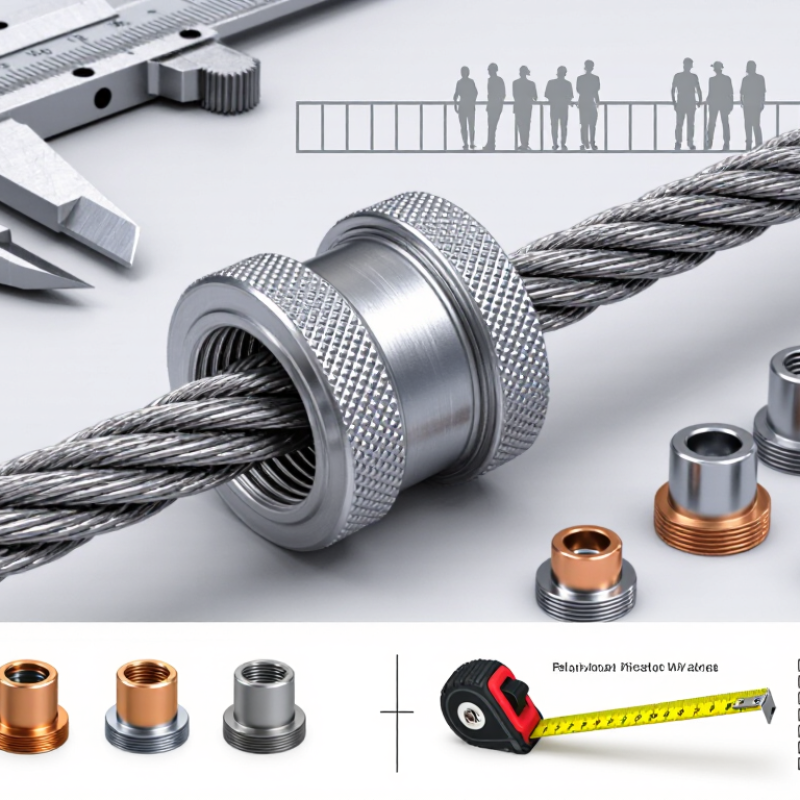
Aluminum Ferrules: Definition and Role in Wire Rope Assemblies
Aluminum ferrules are sleeves that secure a wire rope loop after swaging. They create a compact termination without knots or bulky fittings. In practical assembly work, I have found them useful for light-duty lifting, cable guides, and tensioned lines. Their low weight helps reduce the assembly’s overall mass. Aluminum also resists ordinary atmospheric corrosion, although it is not immune to damage or oxidation.
The ferrule transfers pressure around the rope strands. Proper compression locks the loop and helps maintain its shape under load. Performance depends on the rope diameter, construction, ferrule size, and swaging method. A mismatched sleeve can slip, deform, or weaken the termination. This is where assumptions can fail. Aluminum is not always the best choice for severe abrasion, high heat, or demanding load cycles. Inspect flattened sections, broken wires, cracks, and movement before use.
Tips: Measure the rope accurately. Select a compatible ferrule. Use the correct swaging die. Make even compressions along the sleeve. Do not rely on appearance alone; test the finished assembly under controlled conditions. Leave the eye smooth and free from sharp edges. Recheck it after initial loading, because small seating changes may appear later.
How Aluminum Ferrules Secure and Shape Wire Rope Ends
Aluminum ferrules secure wire rope by compressing a sleeve around a folded rope end. The crimp creates a controlled grip, while the sleeve gives the termination a clean, compact shape. This matters near pulleys, eye fittings, and tight anchor points. A properly formed ferrule also helps prevent strand separation during handling and repeated loading. EN 13411-3 evaluates ferrule terminations through tensile performance, not appearance alone. That distinction is important. A neat crimp can still be unsafe.
Technicians should match the ferrule, rope diameter, rope construction, and die profile. Wire Rope Technical Board guidance also emphasizes correct pressing and inspection after assembly. Look for full die marks, stable alignment, and no cracked metal. Measure the finished sleeve against the specified dimensions. Never assume more pressure means better security. Excessive compression may damage internal strands, while insufficient compression can allow slippage. The U.S. Bureau of Labor Statistics recorded 5,283 fatal occupational injuries in 2023, showing why small connection details deserve serious attention. That figure does not isolate ferrule failures, but it reinforces the need for documented checks. ISO 2408 also supports testing rope performance against defined breaking-force requirements. Aluminum is practical, but not universal. Heat, corrosion, vibration, and shock loading may require a different termination method. That assumption needs checking.
Choosing the Right Aluminum Ferrule for Each Wire Rope Design
Aluminum ferrules are useful in wire rope assemblies because they are light, workable, and easy to form. Yet the ferrule must match the rope design, not only its diameter. A 1x7 rope behaves differently from a flexible 7x19 rope. Strand movement, coating thickness, and loop size all affect the finished connection.
For a compact 1x7 rope, choose a ferrule that provides firm compression without crushing the strands. A 7x19 rope may need a different internal profile and longer sleeve. Coated rope requires extra care. The coating can change the actual gripping diameter. Always compare the measured rope size with the ferrule manufacturer’s sizing table. Do not rely on appearance alone.
Tool control matters just as much. Use the specified die, press, and number of compressions. The sleeve should form evenly around the rope, with no sharp split or loose edge. I once focused on ferrule length and overlooked the coating thickness. That shortcut looked efficient, but the connection required rework. Small details matter.
Environmental conditions also influence selection. Aluminum resists many outdoor conditions, but contact with dissimilar metals may create corrosion concerns. A protective barrier can help in damp installations. For high-cycle, high-load, or safety-critical assemblies, verify the design through documented load testing and inspection procedures. Check the rope tail, ferrule shape, and thimble position after assembly. Better choices begin with the complete rope design, not a ferrule picked from a crowded drawer.
Why Use Aluminum Ferrules for Wire Rope Assemblies?
Choosing the right aluminum ferrule starts with the rope diameter, construction, and required termination length. The chart shows a practical 4d–5d ferrule-length design range, where d is the nominal wire rope diameter.
These values are representative sizing guidelines for preliminary design. Final ferrule selection must be verified against the actual rope construction, ferrule internal diameter, swaging method, working load, and applicable safety requirements.
Installation, Inspection, and Maintenance of Ferruled Wire Ropes
Aluminum ferrules create a compact termination for wire rope assemblies, but reliable performance depends on correct installation. Select a ferrule matched to the rope diameter, construction, and intended load. Insert the rope fully through the ferrule, form the required eye, and return the tail through the sleeve when specified. Use the correct swaging die and complete every press evenly. Do not hammer the ferrule into shape. That shortcut can hide internal damage.
The finished termination should show a clean, uniform crimp without sharp edges or deep cracks. Measure the swaged section against the approved specification, not visual judgment alone. Check the rope tail, eye size, and ferrule position before applying tension. A neat sleeve is not proof of strength. It is easy to miss.
Inspect ferruled wire ropes before each use. Look for crushed strands, broken wires, sleeve movement, corrosion, and unusual flattening near the eye. Pay close attention after shock loading or contact with rough edges. During maintenance, keep the assembly clean and dry. Remove dirt with a soft brush, then use a compatible rope lubricant when required. Never reuse a deformed ferrule. Replace the complete assembly when damage affects the rope or termination. In practice, inspection records help reveal gradual changes that memory often misses. Load testing should follow the applicable specification and be performed with suitable equipment by trained personnel.
